
From Grandma’s Kitchen to Today’s Smoothie
Share
The body carries memories. Not just genetic ones — but culinary ones too. It’s grandma’s cinnamon in the porridge, the rosehip soup that was boiled every autumn, the beetroot that always sat on the Christmas table. Long before we talked about "superfood" or "hormone balance," generations of mothers were intuitively caring for themselves and their families with what nature had to offer.
Now it’s almost Mother’s Day — and we want to celebrate exactly that. The quiet, daily care that mothers of all ages carry. And show how the ingredients behind our blends Heavenly Her and Hormone Harmony are deeply rooted in that very tradition.
What grandma knew — but science later proved
Long before the term "adaptogen" existed, mothers and grandmothers cooked with ingredients that we now understand are so powerful. Cinnamon in the porridge. Rosehips on the hedge. Spinach and kale from the garden. Beetroot in the cellar. It wasn’t a trend — it was tradition.
And in that tradition lay an intuitive nutritional intelligence that modern research now confirms again and again.
"The knowledge passed along at a kitchen table is sometimes more lasting than the knowledge written in books."
Take cinnamon as an example. Scandinavian mothers have seasoned porridge with cinnamon for generations. Today we know that cinnamon contains bioactive compounds and is a rich source of antioxidants. Or rosehip — a Nordic autumn tradition of making soup and cordial — which turns out to be one of the richest natural sources of vitamin C we know, with up to 400 mg per 100 g.
What’s fascinating is how traditions in different cultures have arrived at similar conclusions. Andean culture used maca to support the body in high-altitude climates. Ayurvedic nutrition has revered ashwagandha as an adaptogenic root for more than 3,000 years. Nordic farming culture built beetroot and kale into the yearly rhythm. In common: they listened to nature and the body.
🌿 Traditional ingredients — and what they contain
- Cinnamon — Nordic kitchen classic, rich source of antioxidants with a long history in traditional food
- Rosehip — Nordic superfood, one of nature’s richest sources of vitamin C (approx. 400 mg/100 g)
- Beetroot — a staple in Swedish pantries since the 1800s, contains folate and fiber
- Kale & spinach — grandma’s garden, rich in vitamin K, folate, and iron
- Goji berries — traditionally used in Chinese cuisine for thousands of years, contain vitamin C and iron
- Maca & ashwagandha — Andean and Ayurvedic traditions, now available to us all
🌱 The young mother (20–35 years): building the foundation
For the young mother, a lot is about energy — about managing a body in change and creating healthy habits that can last. Maybe you’re a new mom, maybe you’re expecting. Maybe you’re 28 and want to build the lifestyle you’ll carry for the rest of your life.
What mothers in earlier generations taught their daughters were simple, daily rituals. A handful of spinach in the food. A cup of rosehip tea in the morning. Knowing that the beetroot in the salad wasn’t decoration — it was nutrition. Nutrition-epidemiology research confirms: it’s the consistent, everyday choices that shape health — not occasional detox weeks.
☕ Recipe: Energy smoothie with Heavenly Her
5 min · 1 serving · Perfect for the morning rush
- 1 tsp Heavenly Her
- 1 frozen banana
- A handful of frozen raspberries or blueberries
- 200 ml unsweetened oat milk
- ½ tsp grated ginger
- 1 tsp raw honey (optional)
Blend everything for 45 seconds. Drink immediately. Top with coconut flakes and fresh berries if you like.
4 everyday tips for the young mother
- Build the kale habit: Kale is rich in vitamin K, calcium, and folate. A teaspoon of Heavenly Her in your morning smoothie is an easy way to include it daily.
- Start with rosehips: Grandma’s rosehip soup wasn’t crazy — rosehips contain up to 400 mg of vitamin C per 100 g, which is far more than oranges.
- Beetroot in everyday life: Beetroot contains folate and fiber. Add it to smoothies, hummus, or roast it in the oven.
- Prioritize recovery as highly as exercise: A generation of mothers slept more and stressed less. Listen to your body — and give it time to recover.
🌺 The mother in the middle (40–55 years): balance in life’s most intense phase
For many women in their 40s and 50s, life is at its most intense. Career, teenage children, aging parents — and in the middle of it all, a body beginning to negotiate the terms. Hormone balance changes. Energy levels fluctuate. Sleep needs more care.
It’s exactly at this stage of life that generations of wisdom has the most to say. One generation ago, mothers cooked from scratch. Roasted spices by hand. Brewed herbal teas. It was an intuitive form of self-care that modern adaptogens like ashwagandha and maca now give us access to in an easy-to-use form.
"Taking care of yourself is not selfishness — it’s the most generous thing you can do for the people you love."
🌙 Recipe: Grandma’s Evening Harmony – warm evening drink
5 min · 1 serving · Signals to the body that it’s time to wind down
- 250 ml warm oat milk or almond milk
- 1 tsp Hormone Harmony (ashwagandha, maca, cinnamon, goji berries, lucuma)
- ½ tsp extra cinnamon
- 1 pinch cardamom
- 1 tsp raw honey (optional)
Whisk together and pour into the warm milk. A calm evening ritual in a cup.
Habits for balance and recovery
- The evening ritual: A warm drink with Hormone Harmony, cinnamon, and cardamom in the evening. Calm, warming, and a routine that signals to the body it’s time to wind down.
- Move in the morning — before the phone: A generation of mothers started the day with movement, not a screen. 15 minutes of walking or yoga sets a different tone.
- Eat colorfully: Beetroot, kale, goji berries, rosehips — the pigments in natural ingredients are often the bioactive compounds. The more color on the plate, the broader the nutritional profile.
- Support gut health: Fermented foods like sauerkraut, kefir, and kimchi are ancient traditions in many cultures. A healthy gut microbiome is central to overall well-being.
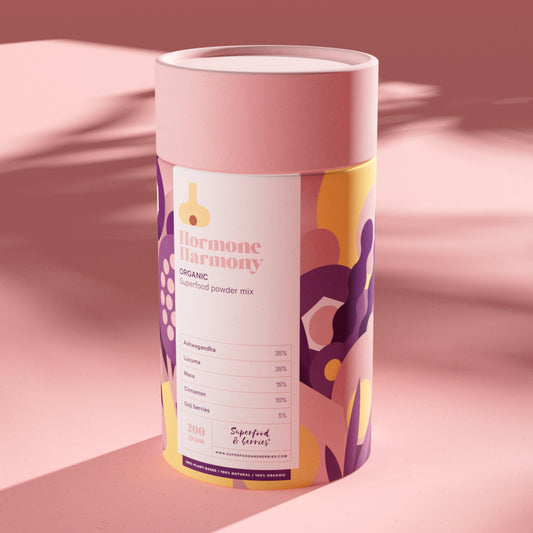
🌿 What does Hormone Harmony contain?
- 🌿 Ashwagandha — Ayurvedic root with a history of more than 3,000 years, traditionally used in Indian natural health
- 🌱 Maca — Andean high-altitude plant, rich in minerals and amino acids, used by the Quechua people since the Inca era
- 🟡 Lucuma — Peruvian superfruit, natural sweetness, contains beta-carotene, iron, and zinc
- 🍒 Goji berries — rich in natural vitamin C, traditionally used in Chinese cuisine for thousands of years
- 🍂 Cinnamon — classic Scandinavian spice, rich in antioxidants, well known in traditional food worldwide
🌾 The experienced mother (60+ years): superfood of wisdom
A woman in her 60s carries experiences no app can replicate. She knows what lasts — and what doesn’t. She has seen health trends come and go. And often she has, without labeling it, lived closest to what we now call a "Blue Zone-inspired" life: moving in daily life, cooking from raw ingredients, eating seasonally, prioritizing sleep and community.
It’s a lifestyle that research into the so-called Blue Zones — the world’s regions with the most centenarians — confirms as central to a long and vital life.
Habits to keep — and rediscover
- Keep the kitchen routine: Regular home cooking is linked to better diet quality and lower intake of ultra-processed foods.
- Walking is still king: Grandma’s daily walk is well-founded. A daily 30-minute walk is part of WHO’s recommendations for supporting cardiovascular health.
- Alfalfa sprouts — don’t forget them: Alfalfa sprouts contain vitamin K, calcium, and chlorophyll. Add them to salad or blend them into a smoothie.
- Social eating: In the Blue Zones, people rarely eat alone. Meals are social glue. Invite others — and eat more slowly.
Habits we’ve lost — and should bring back
The downside of modern life is that in our pursuit of efficiency, we’ve given up some of the most health-promoting habits we’ve had. Here are five habits from earlier generations of mothers that deserve a revival:
- 🍲 Make broths and soups: Long cooking times release minerals from vegetables and legumes. An old homemaking habit that’s simple and inexpensive.
- 🍓 Eat with the seasons: Strawberries in summer, root vegetables in autumn, stored apples in winter. Seasonal food is both more nutrient-dense and more ecological.
- 🥒 Pickle and ferment: Sauerkraut, pickled beetroot, filmjölk — these traditions support the diversity of the gut microbiome.
- 🍵 Herbal tea as an evening ritual: Chamomile, rosehip, hibiscus — simple, powerful routines that signal rest time to the body.
- ☀️ The midday break: One generation took a natural break in the middle of the day. Shorter recovery pauses during the day are important for the body’s stress regulation.
Female Harmony – the package for her
We’ve put together a thoughtful bundle offer for all mothers — whether she is 28 or 68. Female Harmony combines Heavenly Her and Hormone Harmony in one package, at 10% lower price than buying separately.
🎁 Mother’s Day gift
Female Harmony
Heavenly Her + Hormone Harmony · 2 × 200 g organic superfood
100% plant-based · No added sugar · SMAK-certified organic
480 SEK 432 SEK Save 10%
Buy Female Harmony →References
- EFSA (European Food Safety Authority). Scientific Opinion on the substantiation of health claims related to vitamin C. EFSA Journal 2009. efsa.onlinelibrary.wiley.com
- Chandrasekhar K, Kapoor J, Anishetty S. A prospective, randomized double-blind, placebo-controlled study of safety and efficacy of a high-concentration full-spectrum extract of Ashwagandha root. Indian J Psychol Med. 2012;34(3):255–262.
- Peres SL, et al. Medicinal effects of Peruvian maca (Lepidium meyenii): a review. Food & Function. 2020;11(1):83–92. pubmed.ncbi.nlm.nih.gov
- Negrean OR, et al. Bioactive Compounds and Antioxidant Activity in the Fruit of Rosehip (Rosa canina L.). Antioxidants. 2023;12(4).
- Carlsen MH, et al. The total antioxidant content of more than 3100 foods, beverages, spices, herbs and supplements. Nutrition Journal. 2010;9:3.
- Jaiswal AK, et al. Kale: Review on nutritional composition, bio-active compounds and health beneficial properties. Cogent Food & Agriculture. 2020;6(1):1811048.
- WHO. Global recommendations on physical activity for health. World Health Organization, 2020. who.int
- Buettner D. The Blue Zones: 9 Lessons for Living Longer. National Geographic Society, 2008.
- Nordic Council of Ministers. Nordic Nutrition Recommendations 2023. Copenhagen, 2023.
- SMAK Certification. SE-EKO-03 organic certification. smak.se